The short answer

Buy them the one they like looking at the most.

If they love dinosaurs, get ‘em the Dinosaur kite, if they love Unicorns, get the Unicorn kite, if they think the Shark looks great then it’s the kite for them. Check a few things first, (read on to see what to check for…) but, if you’re looking for the best kite to get your kids, this is the best rule to use.

dinosaur printed single line delta kite flying in the distance

Good quality long-tail deltas are brilliant flyers in a wide wind range…

Trust that we, as kite ‘experts’, have done our job properly and are only offering you kites we know will be good flyers for kids. (We’ve got lots of specialised kites like Box kites and large parafoils but we don’t put them on the Kids Kites page because they’re not suitable for kids.)

7 year old girl flying rainbow diamond kite on the beach

You don’t need to run to get a good kite up but, hey, it’s heaps of fun!

The slightly longer answer

Two things make a kite a good flyer for children:-

1. Wind Range (Lift)

Wind Range is important.
The kite your kids like to look at is not much good if it needs cyclonic winds to get off the ground.What you want is a kite that will fly in a wide range of winds.
This means there are more days when you can play with it.

Rainbow delta single string kite flying in the distance

A big sail area gives good lift but more is not always better

2. Stability (drag)

Stability is critical.
A beautiful kite is not much fun if just spins around in circles and then crashes into the grass.
There are many ways that we, as good kite designers, can get stability in a kite. Things like Tails, Drogues, Keels or Cells to name a few.

jellyfish australian made childrens kite

The right amount and right type of tail = stability

All of the kites on our Kites for Children page will have these 2 things, (ah, otherwise we wouldn’t have them on that page!)

Stop evading the question, what’s the best kite for kids?

Well, that depends (ah, more evading…) on those two things again:- Lift and Drag.

Wind Range:

A small kite will not be able to fly in light winds (not enough sail area).
For example, the Rainbow Diamond is a nice little flyer, but it needs more wind then, say, a Waves or Unicorn Diamond because they are bigger kite with much more sail area to catch the wind and generate ‘lift’.
This means that there are more days that you will be able to go flying with the bigger kite because it has a wider wind range, it will fly on more days. It has a ‘wider wind range.’

beaufort wind scale for kite flying

Kite flyers use the Beaufort wind scale to describe what happens at different wind speeds

Want to know more about the beaufort wind scale? – here’s what wikipedia has to say.

So, are bigger kites better?

Generally yes, but there is also weight…the heavier the kite the more wind it will need. This is just common sense I guess and this is why we put both of these things together in what we call a ‘sail to weight ratio’.

  • Big sail + Light but strong Frame = good sail:weight ratio
    = great for light and medium winds.
  • Small sail + Light Frame = average sail:weight ratio
    = not so great in either light or medium winds.
  • Small sail + Heavy Frame = crappy sail:weight ratio
    = pretty crappy flyer.
Cell Delta Single String kite with wingtip tails in flight

Ok, got it. So why not make all kites big and light?

A couple of reasons:-

  • Bigger kites are more expensive and some people only have a ‘rainbow diamond budget’
  • Lighter kites are often more fragile and their light frame can break more easily if they are not well designed.
  • Some designs, like Box kites and 3D Stars, are really complex and need lots of strong framing to keep them together so probably not the best kites for kids.
    Again, they are not on our ‘kites for kids kites page because they don’t tick the two ‘Stability’ and ‘Wind Range’ boxes necessary to be a good kids kite.
    Nevertheless, they are still excellent specialised designs and great for adults to fly.. 

So wind range is important…..anything else?

Stability:

You want a kite to stay in the sky and be fairly steady as it sits there.
A kite that spins around in circles then crashes to the ground is not much fun for you or the kids. When a kite is ‘unstable’, it spins in circles then eventually hits the deck. This is what most people are talking about when they say ‘it just wouldn’t fly’ about the cheapie kite they bought from the chain stores or from some unknown online site ‘overseas’.

What makes a kite stable then?

Well, drag. drag gives stability, and  this comes from 2 things;- – Correct Tail and Good Design.

Stability in a kite is no different to stability in a bird or an aeroplane. We’ve all seen the movie scenes where the tail gets blown off the aeroplane and it spins and spins until it crashes. This is because it’s lost it’s ‘drag’.

Australian made diamond tricolour single string kite flying in the distance to show long tails

Most kites get their drag from Tails because it’s pretty foolproof and they look pretty nice. The Diamond Tricolour kite is a really stable flyer because it’s got the right amount of drag from having the right amount of tail. It’s important to have the right amount.         

  • Not enough tail = not enough Drag
    = spins around and crashes.
  • Too much tail = too much weight
    = won’t lift off the ground or needs lots more wind to fly.
Cell Delta Single String kite with wingtip tails in flight

The middle purple cells make it very stable.

It’s not just Tails that can give a kite stability though.
It’s good design also.
Designs like the Cell Delta have a ‘cell’ built in to the middle of them that makes them very stable.
Our Eagle kite is very stable and it has no extra ‘tail’ at all. (ah, we don’t claim any originally in this design though, birds have been doing it for millions of years!)

multicoloured lorikeet Bird shaped kite for kids in flight

How does this work?
Dunno, I just copied what a bird does!

Wind Range – Will the kite your children like fly in a wide wind range?

Different kites and different kite types need different winds to fly. Delta kites for example are very efficient and will fly in light winds. Box kites on the other hand need a fairly fresh breeze to stay aloft. This doesn’t make Box kites bad kites, they’re just designed for stronger winds and are really stable in those stronger winds.

Where do you live?

So…. if you live in INLAND or in a light wind area like Mt. Isa or Broken Hill, get a kite that suits the light winds you mostly get

Junior Delta Australian made single string kite for kids in the sky

Big sail area and correct frame size = Light Winds

Delta kites like the Junior Delta or the Patchwork are great for these light winds because they have a big sail area to catch the wind. They are also great in Medium winds.

large single string delta kite with quilted patchwork pattern flying

For light winds, deltas are excellent flyers.

pocket parafoil kite with long tail and drogue

Parafoils need lots of wind to fill their cells to keep the shape rigid.

In light wind areas.
Stay away from Parafoils and Box Kites because they need lots of wind to keep them up. They are excellent in stronger winds, but don’t get them for light or medium winds.

Box kite flying

Box kites are excellent for strong winds but no so good for light winds

However, if you live on the Coast or in a Medium Wind area…

Near the Coast.
Most people in Australia live near the coast so will regularly get a good range of winds from Light, Moderate and Fresh through to Strong. Just about all of our Single String kites will fly well in these areas. Here’s a quick rundown on the main groups and how they will perform.

Diamond kites like the Waves or the Unicorn  are really good for medium to fresh winds because they have a ‘bow’ (or bend side to side) and long tails. This gives them great stability.
As well as this, we’ve designed them with the right balance between SAIL AREA and FRAME WEIGHT so they can perform in this range of winds.

Waves childrens kite flying in the distance showing long tails

Waves diamond

Unicorn diamond kite for children flying in the distance to show long tails

Unicorn diamond

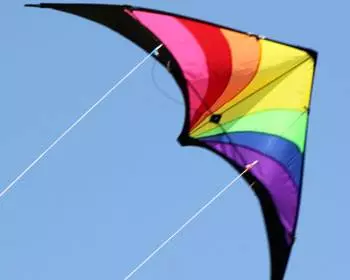
Rainbow delta long tailed kite for kids in flight

Rainbow delta

Delta kites like the Rainbow Delta or the Spider Delta  are also excellent in there coastal winds because they have big sail area to catch the wind as well as long wide tails for stability.
Again, designed with the right balance between SAIL AREA and FRAME WEIGHT.

red and black delta shaped kite with spider printing. This is a Single string children's delta kite

Spider delta

Single string Shark kite flying in the distance

Shark – sort of like a Delta

beautiful rainbow colored butterfly shaped single string kite

Butterfly – sort of like a Diamond

Compound kites like the Shark or the Butterfly as well as the Eagle and the Fire Dragon also do really, really well in these winds because of a well designed balance between big sail area and just the right amount of tail.
These types are an excellent choice in winds from Moderate up to Fresh.

You will note that I am not recommending anything for Strong winds. This is simply because I don’t recommend that kids go flying in strong winds. They are generally gusty and unpredictable and the extra power they generate can easily pull a kite handle out of a child’s grip with the resulting lost kite and tears. If the wind is really strong, come back another day.

Ok, that’s how to choose a good flyer. What should I stay away from?

cheap delta with 2 short tails

Short tail = unstable flyer


Hard to be specific about all kites but, in general, stay away from small cheapie Deltas and Diamonds with short tails…their tails are way too short to give them stability and they will spin around and crash in Medium winds.
I’d also be very wary of cheap Diamonds or Deltas with Bride Strings. They are usually fixed in place so you have no means of adjusting them to change the angle of attack of the sail into the wind.

cheap diamond kite with 2 short tails

Fixed bridle string = no adjustability

Ok, by now you’ve probably got the message that there is no one best kite, it’s more of ‘kites you should stay away from’ because they lack lift or stability. (The cheap ones are cheap for a reason!)

So…what is the best kite for kids to fly?

– Get your children a kite they will like looking at.
– But first check that it has two important qualities:-
* A Wind Range to suit where you live
* Good design or tail length to give it good stability

then, if you’re happy with the quality of materials and quality of workmanship, (you can get a good idea of these from the warranty the kite shop is offering you) then you should be good to go…

One last question – what’s your favourite best kite for kids?

Easy question, I’ll pick a Jellyfish every time!

  • super easy to fly
  • looks great in the sky
  • Australian made
  • wide, wide wind range
  • no assembly needed
  • kids love to watch it wiggle and dance
  • simple design
  • really stable in the sky
  • beautiful colours
beautiful girl flying a pink jellyfish with 6 long rainbow colored tails on the beach at Cairns in North Queensland

The Jellyfish – perfect kite for young children at the beach or the park

I hope this has answered your question about which kite to buy for your children?

If you’ve got any followup questions, just let me know and I’ll do my best to make up an answer for you 🙂

Happy flying…